We have repeatedly written about the dollar's desire to achieve parity with the euro 1:1. But we did not expect that this could happen so quickly: the EUR/USD pair found a local bottom at the level of 1.0071 on Friday, July 08. Only 71 points remained until 1.0000. The last time it was so low was in December 2002. The week's high was recorded at 1.0462. Thus, the US currency squeezed out the European currency by almost 400 points from July 04 to July 8. And there are two reasons for this.
EUR/USD: One Step to 1.0000
The first is the general strengthening of the dollar, whose DXY index has renewed 20-year highs and reached a height of 107.77 on July 08. As before, the main reason for such dynamics lies in the tightening of the monetary policy (QT) of the US Central Bank. The minutes of the June meeting of the FOMC (Federal Open Market Committee) published on Wednesday, July 06 confirmed once again the regulator's desire to curb inflation at any cost. The main tool here should be a sharp increase in the refinancing rate for federal funds. Remember that the rate was raised immediately by 0.75% in June, for the first time since 1994. As follows from the FOMC minutes, the members of the Committee believe that the rate will be increased by another 50-75 basis points at the next meeting on July 27.
Recall that the head of the Fed, Jerome Powell, who participated in the ECB forum in the Portuguese city of Sintra, assured the audience that the US economy is well positioned to cope with the active tightening of monetary policy, which is being implemented by his department.
It should be noted here that there is a rather rare situation in the markets when US stock indices also grow along with the growth of the dollar. Thus, the S&P500 grew by 7.5% (from 3635.60 to 3910.60) since June 17, and the Dow Jones - by 6.1% (29646.60 to 31463.00). The reason for this, most likely, is that investors invest part of the dollars received from the sale of the euro, other currencies, as well as risky assets of other countries, in shares of American companies. And this is despite the fact that Jerome Powell made it clear at the press conference in Sintra that a recession in the US economy is inevitable, and the Federal Reserve Bank of Atlanta announced that US GDP could decline by 2.1% in the current quarter. But, apparently, the situation in other countries is even worse, so investors have very limited choice. The second factor pressuring on the EUR/USD pair is the problems of the European economy related to the sanctions, which threaten the EU with a protracted energy crisis.
ECB President Christine Lagarde said a week ago that “inflation expectations in the Eurozone are much higher than before”, that “we are unlikely to return to conditions of low inflation soon”, and that the regulator “will go as far as necessary to reduce inflation to the target of 2%”. But less than a few days later, Bundesbank chief Joachim Nagel urged the ECB to be extremely cautious in terms of tightening monetary policy, as raising interest rates would push the eurozone's weakest economies to the brink of bankruptcy. As a result, the market decided that the regulator would raise the key rate very slowly and responded to the words of Joachim Nagel with an even more active sale of the euro.
It should be noted that the release of macro statistics has recently become just an excuse for a correction or, conversely, for a return to the general bearish trend: in total, the pair has lost about 2,200 points since January 2021, and the fall has been more than 5,800 points since July 2008. After a small correction, the last chord sounded at the level of 1.0177 last week. At the time of writing the review, on the evening of July 08, the voices of experts are divided as follows: 65% of experts expect the resumption of movement to the south, 15% side with the bulls and 20% cannot decide on the forecast. The indicator readings on D1 give a completely unambiguous signal: all 100% of oscillators and trend indicators are colored red. The only thing worth noting is that 15% of the oscillators are in the oversold zone.
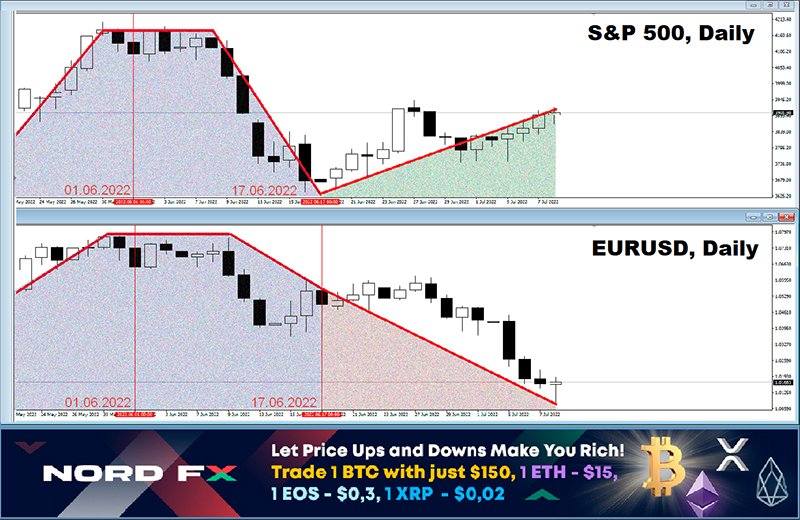
With the exception of support at 1.0160 and last week's low at 1.0071, bears' task No.1 is to celebrate the victory by hitting 1.0000. With a certain degree of probability, due to inertia, the pair may fall even lower, to a strong support/resistance zone of 200, 0.9900-0.9930. In this case, the level of 1.0000 will have to be attacked not by bears, but by bulls. Although this may not happen. Suffice it to recall 2017, when, having fallen to 1.0340, the EUR/USD pair reversed and soared to 1.2555. The immediate target of the bulls is a return to the zone 1.0350-1.0450, then there are zones 1.0450-1.0600 and 1.0625-1.0760. If successful, the bulls will try to rise to the 1.0750-1.0770 zone, the next target is 1.0800.
As for the economic calendar for the coming week, Wednesday 13 July can be highlighted, when data from the consumer markets in Germany and the US will arrive. Another portion of macro statistics can be expected on Friday, July 15, when retail sales and the US University of Michigan Consumer Confidence Index become known.