Stock trading will never cease to be the main point of attraction for those who seek financial freedom. Over the past few years, the stocks issued by technology companies have been on the rise - some of them like Tesla (TSLA) have been putting up tremendous gains, comparable only to those showcased by cryptocurrencies during bullish cycles.
No one is going to argue the fact that our future lies with modern technology. It leads to a simple yet decisive conclusion that the demand for products and services offered by companies beyond the stocks listed below will be in high demand for years to come.
High demand converts to growing revenues, which leads to escalating stock prices - the logic is simple but deadly solid. Betting on tech stocks is almost like a sure thing - only it’s not, of course, but some stocks offer much better protection against economic turmoils which the world is full of these days. I gave this matter some thinking and consideration and came up with a very balanced list of top tech stocks for 2022.
Apple (AAPL)
Those who are even vaguely familiar with the technology sector know that Apple belongs to a small cohort of corporations that are rightfully considered the biggest whales of all whales. In fact, Apple is the biggest corporation in the world by market capitalization that presently amounts to $2.73 trillion - nearly half a trillion more than its closest rival Saudi Aramco.
The company is an undoubtful leader in such spheres as the production of consumer electronics and software. According to the latest stats, Apple’s flagship product, iPhone, takes up 23.4% of the global smartphone market, while its mobile operating system, iOS, has a market share of 27.57%. Add to that the online services provided along with these and other products (iPads and Mac PCs), and you are looking at the stock of the most profitable corporation in the world. In 2021, Apple's reported revenue was $273.9 billion along with a net income of $58.4 billion, which means that its balance sheet is absolutely bullet-proof.
All this data tells us that from the standpoint of fundamentals and company health, Apple undoubtedly is the cream of the crop among corporations, which means that AAPL can be characterized as an ultra-secure blue-chip stock that every self-respecting investor ought to have in his portfolio.
However, if you don’t already own AAPL, you need to consider the fact that at this particular junction, this stock is past its prime in terms of profit provision. It was a great buy around a decade ago when the smartphone market was on the rise. But that trend has already reached its peak so a company of the size of Apple, and the value of its stock, can’t grow at the same pace it had over the past decade.
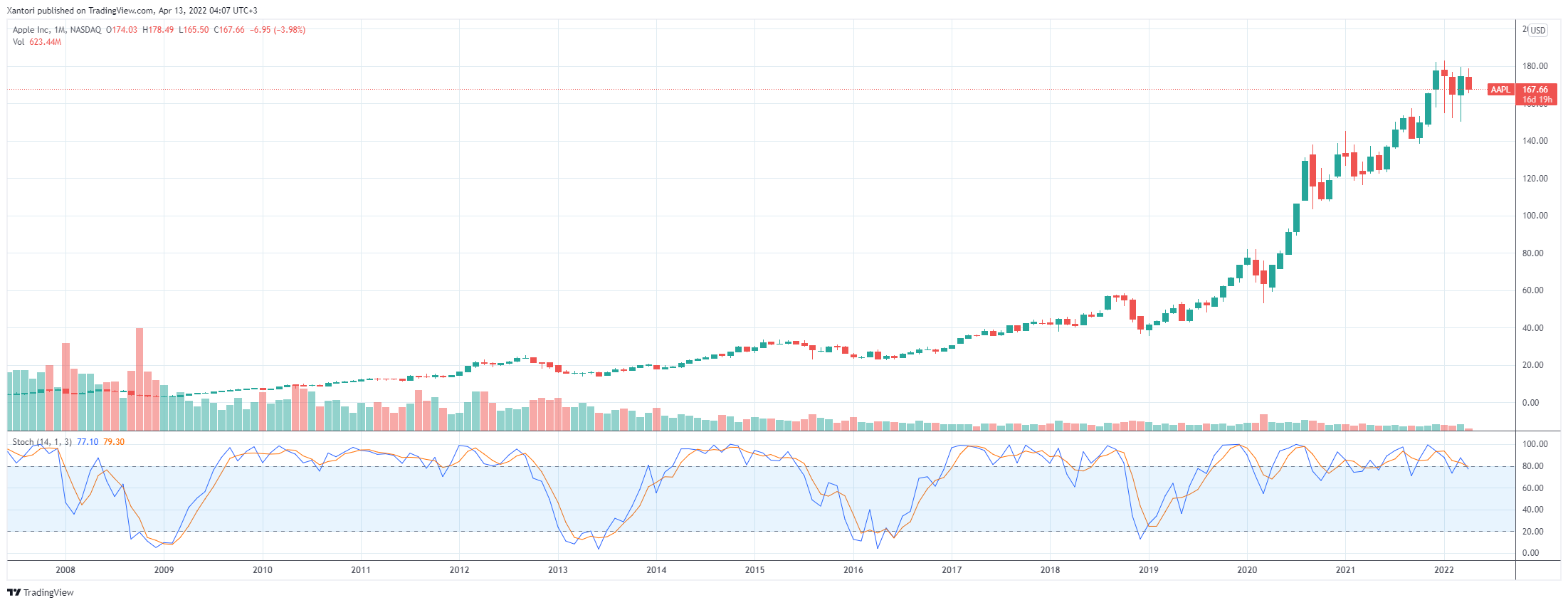
1-month AAPL chart
A glance at the monthly chart above clearly suggests that this market is overheated from the ceaseless 440% rally that took off at the beginning of 2019 and got disrupted only by the COVID-19 pandemic. It’s obvious that the uptrend has stalled while the Stochastic has been in the overbought area for an entire year. We have no doubt that AAPL will go past $200/share eventually, but it would be wise to get into this market only after imminent correction.
- Pros: AAPL is an ultra-premium stock with impeccable health.
- Cons: The stock could be at the end of the bullish cycle.
- Verdict: AAPL is definitely a crown jewel of every portfolio but at the moment, the market is heading towards a correction.
Microsoft (MSFT)

MSFT is another shining example of the blue-chip stock that had a tremendous bull run over the past twelve years. In this period, the stock appreciated in value by 2100%, having gone from a mere $15.85 to the all-time high at $350. For some time, Microsoft which, as we all know, is the mass producer of computer software, services, PCs, and gaming consoles (Xbox), with a production level that has always been bordering on global monopoly, has been the biggest corporation in the world by market capitalization, though, in recent years, it gave up this position to Apple and Saudi Aramco.
Back in 2013, Microsoft’s market share for operating systems for personal computers was at 93%, but then got reduced to 73% due to the competition with Apple. Nevertheless, that is a huge fundamental advantage over most tech stocks that will remain for years to come. This advantage may even improve if its cloud computing division, Azure, continues to develop at the same pace. The majority of stock analysts predict that MSFT will break past $400 but that probably won’t happen in 2022 as the market starts to cool down.
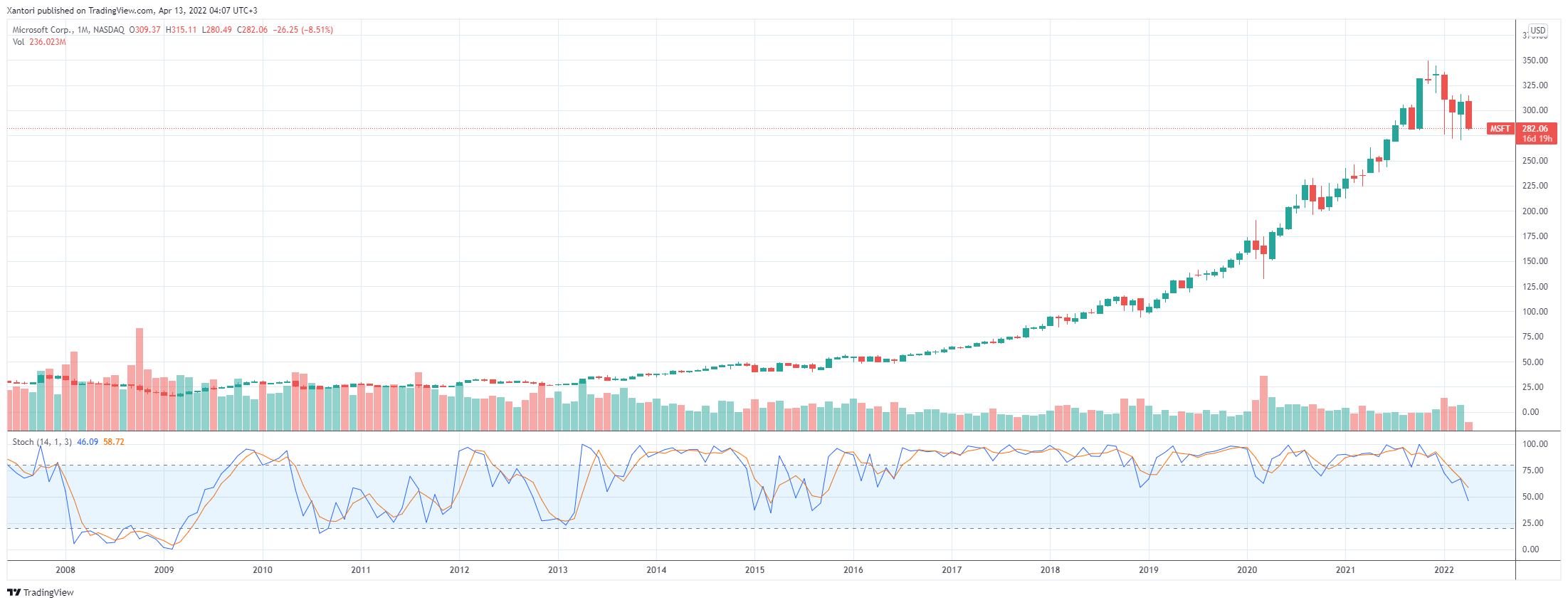
1-month MSFT chart
Similar to AAPL, one glance on the chart is enough to figure out that this market is begging for correction after the price has failed to go past $340 and rolled back by 22% from the all-time high. The Stochastic also clearly signals that the momentum is absolutely bearish. Therefore, it’s highly likely that in the coming months, traders would witness either the correction to $200 or the consolidation around $260.
There won’t be a crash, of course, simply because Microsoft is too big to fail unless some black swan event, the occurrence of which is also possible given the geopolitical turmoils around the world. So gather some patience if you intend to buy this stock at a discount because the consolidation might last throughout the entire 2022.
- Pros: Top-of-the-line stock with upside potential.
- Cons: The resumption of the bullish cycle might take longer than a year.
- Verdict: MSFT is definitely a must-have for any stock trader or investor, but newcomers should exercise caution because the market is changing its structure.
Amazon (AMZN)

The tech corporation that started as an online book store now has a market capitalization of $3.07 trillion which makes it the fifth-largest company in the world. Obviously, there is absolutely no doubt that AMZN's fundamental value is super solid. In our opinion, the key advantage of this tech corporation over the above-mentioned two is that Amazon is constantly diversifying its operations and entering new promising sectors, such as drones, satellite Internet, cloud computing, and even space traveling (the Blue Origin project).
Moreover, figures from the fiscal year 2021 show that the corporation is in the green in terms of revenue, operating income, net income, total assets, and total equity, meaning that the company is thriving. Amazon’s price-to-sales (P/S) ratio is a solid 3.5, with the projected price-to-earnings ratio being 54.5, so it’s safe to say that AMZN has absolutely no health issues, which is a good prerequisite for the continuation of the bull market all the way to $5,000 and beyond, but only after a pause.
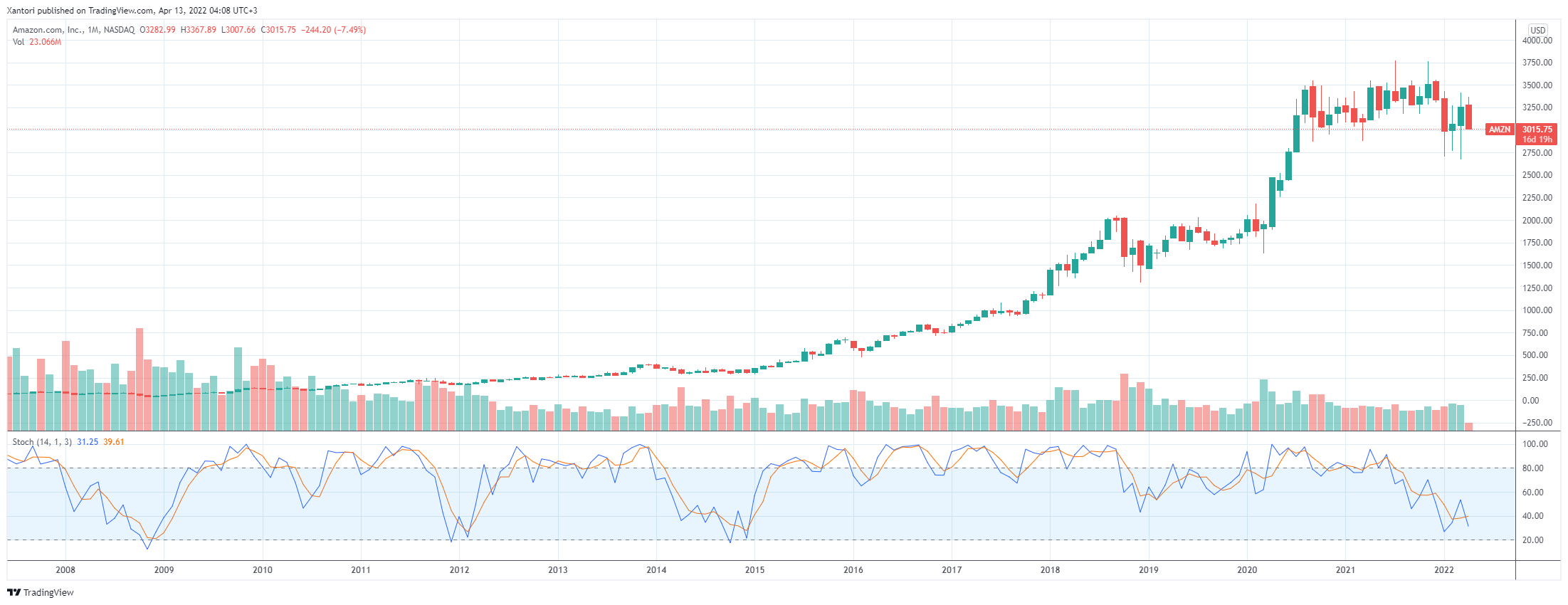
1-month AMZN chart
Similar to other top tech stocks, AMZN is looking at the end or at least a major halt of its bullish cycle that commenced back in 2007. It’s obvious even for the rookie stock trader that the price has encountered an impassable resistance near $3,500, with the all-time high established close to $3,800. The selling pressure forced AMZN to roll back to $2,700 from which point the price bounced off to $3,380 to form the lower high, a sign of the change in the market structure on the backdrop of bearish momentum. The big question here is whether the price remains within the consolidation channel between $2,800 and $3,400 throughout 2022, or would it travel down south. In any case, it’s clear that relatively soon, stock traders will get the opportunity to load up on the premium stock at a discount. But in this situation, the timing for creating a sizable position is of the essence.
- Pros: The top tech stock that might already be in the middle of the consolidation phase.
- Cons: Newcomers might not be able to get into this market for some months.
- Verdict: There is a high possibility of AMZN going to $5,000 but only after a few months of consolidation, or even bearish, phase.
Tesla (TSLA)

The Tesla corporation is closely associated with its founder Elon Musk, the richest man on the planet who seems to have his skin in every financial or tech game, whether it's electric cars, social media, space travel, or crypto. But the Texas-based company is focused primarily on electric cars and clean energy, which is one of the reasons why it’s been getting heavily involved in the lithium mining and refining space. Even though the company was founded only 18 years ago (2003), it already occupies the sixth place in the global corporation rank with a market capitalization of $1,04 trillion.
Similar to Amazon, Tesla has been thriving in all departments, from revenue ($53.8 billion in 2021) to total equity ($30.2 billion for the same period). However, its profitability is characterized by analysts as mediocre in comparison to other big names in the automotive industry. But this concerns the company, not the stock TSLA, the return on assets of which has been calculated at 8.9%, which is way better than the industry average of -12.8%. The same goes for its profit margin which stands at 10.2%, while the rest of the industry players are in the negative.
Tesla’s Earnings per Share ratio is also quite staggering, with 204% growth in the past year and 474% over the past five years. It’s expected that this metric will continue to grow in the coming year at an approximate yearly rate of 27%. But it’s not all rosy for TSLA at the moment since its Price to Earning (P/E) ratio now stands at an ultra-high 147, which means that the stock is now overpriced and the market is likely to experience a drop in the coming months.
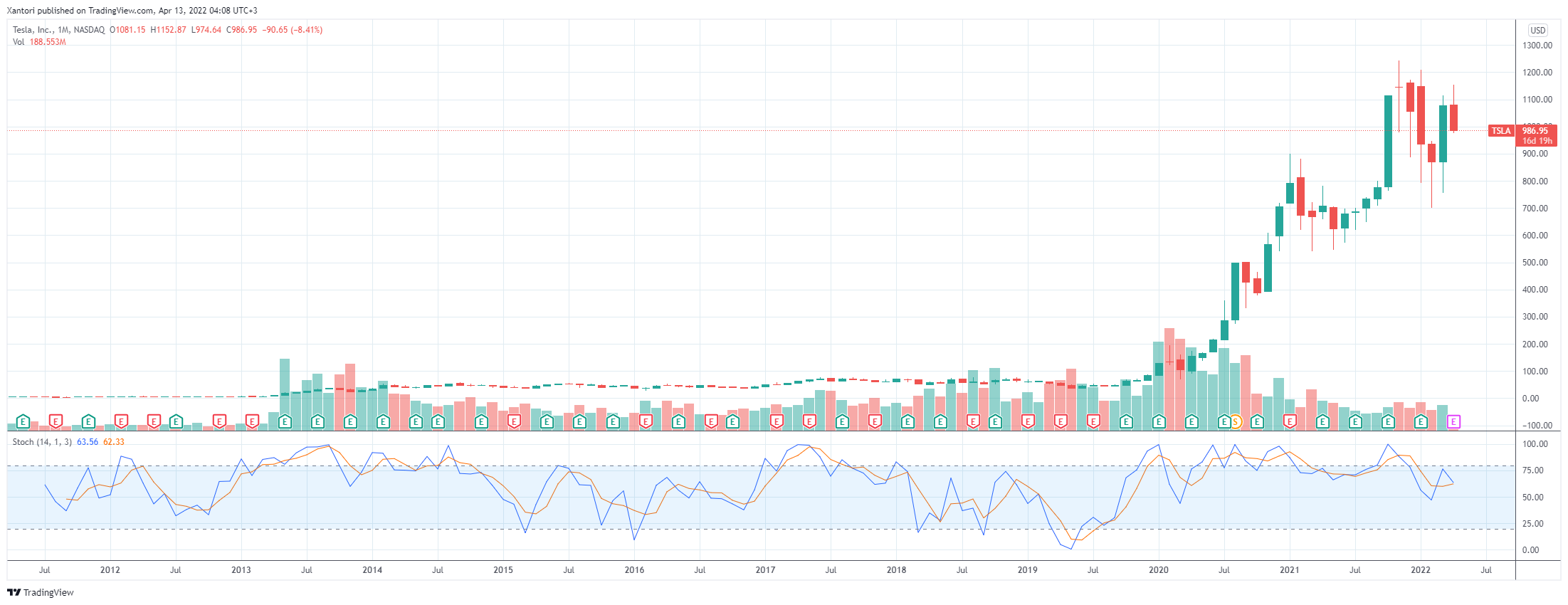
1-month TSLA chart
The market’s overheatedness becomes very obvious when looking at the chart. We expect a significant correction now that the price has formed a lower high and the momentum is getting increasingly bearish. During the first half of 2022, we predict the correction to below $700 from the current $994. But eventually, TSLA will go past $1,500.
- Pros: Electric vehicles are the future of automotive and tech industries which makes TSLA an obvious choice for a savvy investor.
- Cons: The stock is now heavily overpriced - buying it now poses a significant risk.
- Verdict: Having TSLA is a must for any progressive individual, just like owning a Tesla car.
Alphabet (GOOGL)

Like most companies on this list, Alphabet, Inc., which emerged after the restructuring of Google, needs no special introduction. It represents a tech behemoth that revolutionized the Internet and tech industry and earned a place in the Big Five list, which includes Apple, Amazon, and Microsoft. The company’s market capitalization is now estimated at $1.73 billion, which places it right between Microsoft and Amazon.
Alphabet’s stock GOOGL has been on a roll since 2010 as it had a parabolic rally that resulted in the 2195% value appreciation of the stock that was once priced at $130 - now, it’s worth $2,570. Despite being a dominant whale in the tech industry that could rest on its laurels, Alphabet displays great growth and profitability ratings as well as impeccable financial health.
The stock’s Return on Assets and Return on Equity Scores are way above the industry average - the same applies to the profit margin. The Earnings per Share is now at the sky-high level of 91.2%, and we predict that this ratio will stay in the positive of about 13% all the way to 2026. GOOGL’s Price to Earning Ratio is approaching 23, the same as the Forward Price to Earning ratio which points to the fact that the stock in question is overpriced and the correction is to be expected.
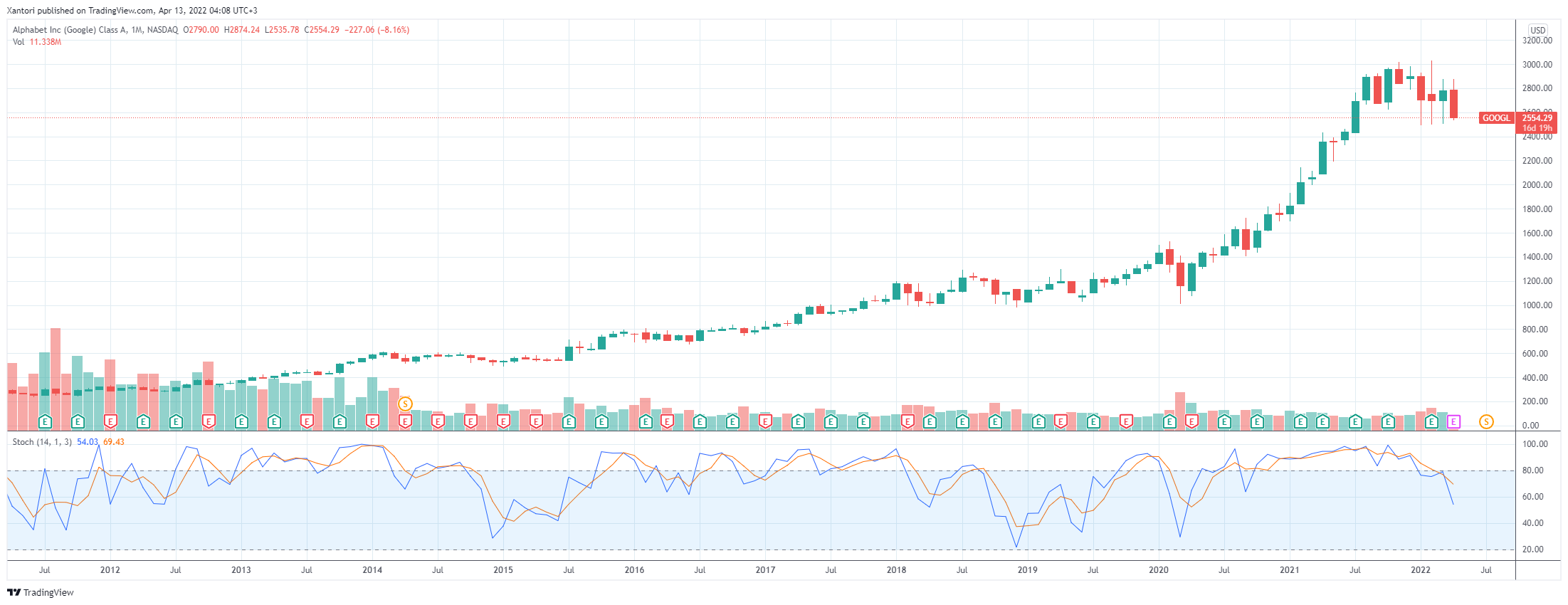
1-month GOOGL chart
Perhaps it has become apparent by now that major tech stocks won’t be seeing any significant growth in the coming months as their respective rallies have peaked, which is also the case for GOOGL. The growing monthly bearish candle is likely to drag the price down to $2,200 or below as the selling pressure mounts.
- Pros: Superior fundamentals and great growth prospects for both the corporation and the stock.
- Cons: Right now, the bull market seems to have run out of steam.
- Verdict: If you have GOOGL stock - don’t hold onto it; if not - wait for it to become cheaper.
Nvidia (NVDA)

Every gamer and cryptocurrency miner around the world had a close encounter with Nvidia products at least once in his lifetime and surely has been cursing at the company for putting a big price tag on its top graphic processing units (GPUs) that are used to mine Ethereum (ETH) and a number of other cryptocurrencies. The Delaware-based company is also known for developing software, AI and cloud computing solutions, video games and producing system-on-chip units (SoCs) and computer hardware.
Being arguably the biggest player in this sector, Nvidia sits in ninth place in the global corporation ranking with a market capitalization of $560 billion and the prospects for pushing Meta off the eighth spot in the near future since its revenue is predicted to grow by 31% yearly, whereas Meta’s expected growth rate is 13.6%.
The company displays superior health and financial stability, which also applies to its stock that has the ticker NVDA. Nvidia’s RoA is an impressive 22% - way above the industry average - while its profit margin stands at 36%, exceeding that of 96% of industry peers. The stock, however, appears to be very overpriced given its Price to Earnings Ratio of 48.4 together with the Forward P/E of 37.8.
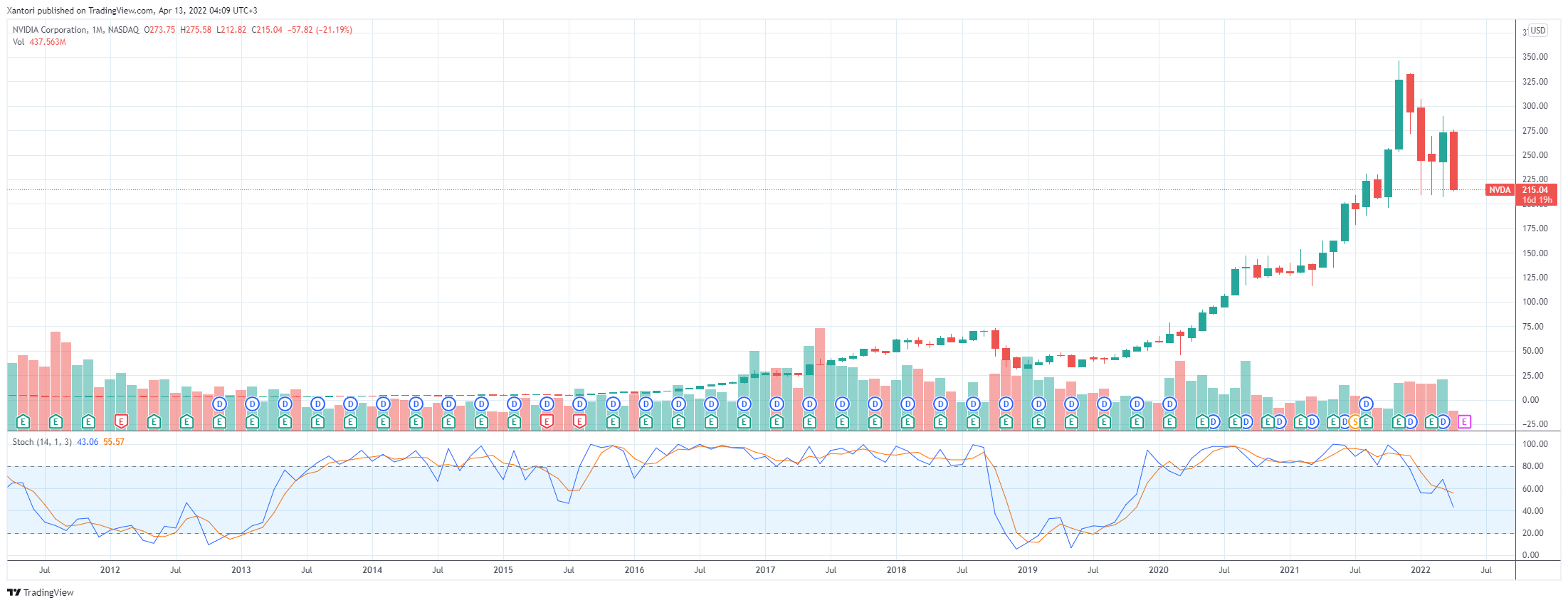
1-month NVDA chart
This has already exerted a tangible impact on the market structure which began to collapse after the price had hit the level near $340. Right now, the stock is priced at $214 - 38.3% down from the all-time high. The 5-month long drop has been quite formidable, and we anticipate its continuation until the price reaches $160. At the same time, the company’s future looks bright as its Earnings per Share are expected to increase by 21.2% over the next five years. So look for the end of consolidation to begin stocking up on NVDA.
- Pros: Great company and stock with excellent growth prospects.
- Cons: The price goes through a violent drop at the moment.
- Verdict: This one should definitely be on your watchlist first, and then in your portfolio.
Verizon (VZ)

Verizon Communications Inc., is the New York-based conglomerate that is considered the second largest telecom company by 12-month trailing revenue (TTM) behind another American tech giant AT&T. Like other technology companies on our list, Verizon did well over the past fiscal year, having recorded an increase of revenue to $133,61 billion as well as net income and total assets. It’s far from being the wealthiest corporation in the world - the market capitalization of $225 billion puts it in the 44th place in global ranks - but it’s certainly one of the most influential in the telecom sector.
Frankly, Verizon didn’t get on our list for having superior fundamentals - let’s just say that they are rock solid, or at least not worse than that of industry peers. The reason why we included VZ in the list of top tech stocks for 2022 lies in the price chart. Let’s just note that VZ has above average Return on Assets/on Equity showings - 6% and 27%, respectively. Its profit margin of 16.5% is twice the industry average.
As for the stock VZ, its Earnings per Share ratio increased by 10% over the past year. The Price/Earnings Ratio is up by the same number, while the Forward P/E ratio is 9.5, meaning that unlike most tech stocks on this list, VZ isn’t overpriced right now and has a good potential for growth in 2022.
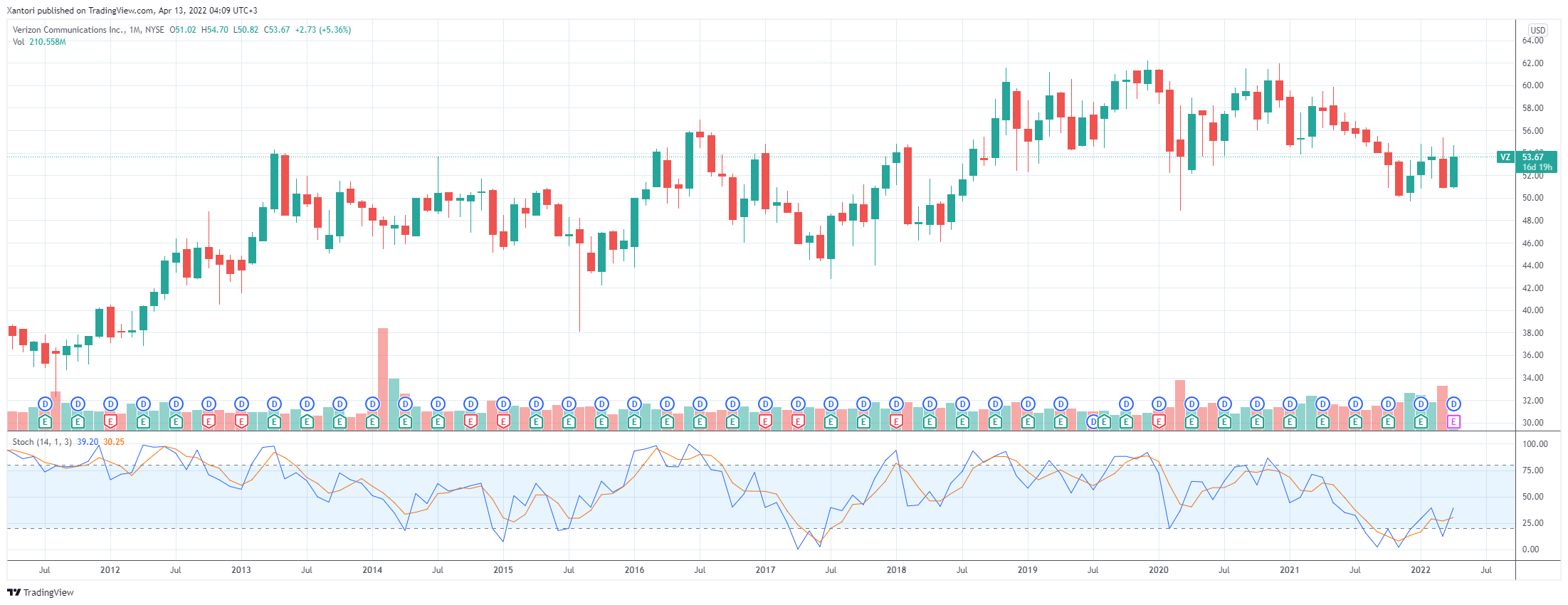
1-month VZ chart
Now to the chart where it’s clear that the price has been in a steady uptrend for the past ten years without any parabolic rallies that would have entailed a deep correction. On the contrary, VZ appears to be recovering after the pullback and the formation of a higher low at $50. At the same time, Stochastic shows bullish momentum, plus it has just begun ascending from the oversold zone. Therefore, we have every reason to believe that VZ will add at least 20% to its value in 2022 and go past the $63 zone.
- Pros: VZ is set up for price appreciation right now as it begins to recover after correction.
- Cons: Verizon’s fundamentals aren’t super impressive but sufficient to call VZ the top tech stock with good upside potential.
- Verdict: VZ isn’t the stock that should be kept in the portfolio for the long haul, but its profit-making potential is evident.
Netflix (NFLX)

Most of you probably heard the expression, “Let’s Netflix and chill” which means binge-watching some TV series streamed on the eponymous online platform developed by Netflix Inc., the production company that operates out of Los Gatos, California. It’s a relatively modest tech company in comparison with Apple or Google - it has a market capitalization of $158,8 billion - but its potential lies in the growing popularity of TV shows as the main form of entertainment.
Despite being a globally renowned brand, Netflix is currently going through a major crisis that reflects in its market capitalization which shrunk from $300 billion to $88.3 billion in little less than six months. NFLX is also having a meltdown as it lost 73.5% of its value since recording the all-time high of $703 in November 2021, around the same time when the market capitalization had reached its peak. The main reasons behind these significant losses are growing inflation, the underwhelming earnings reports, and a loss of up to 2.7 million subscribers in the first two quarters.
Nevertheless, NFLX maintains a very good Return on Assets of 11% and a profit margin of 16.5%, which are far better than those of its industry peers. Besides, the stock maintains a very good Earnings per Share of 33.2%, which is expected to grow by 21% on a year-to-year basis. The company’s revenue growth is expected to slow down in the coming years but still remain at a respectable level of 11.9%. We would also like to note that Netflix had already experienced similar crises which resulted in huge losses in market capitalization, which was down 42.4% in 2004 and 60.7% in 2011. But after each bad year, the company had always recorded a triple-digit growth: 128% in 2005 and 327% in 2013. It’s highly likely that the story will repeat itself in 2023 or 2024.
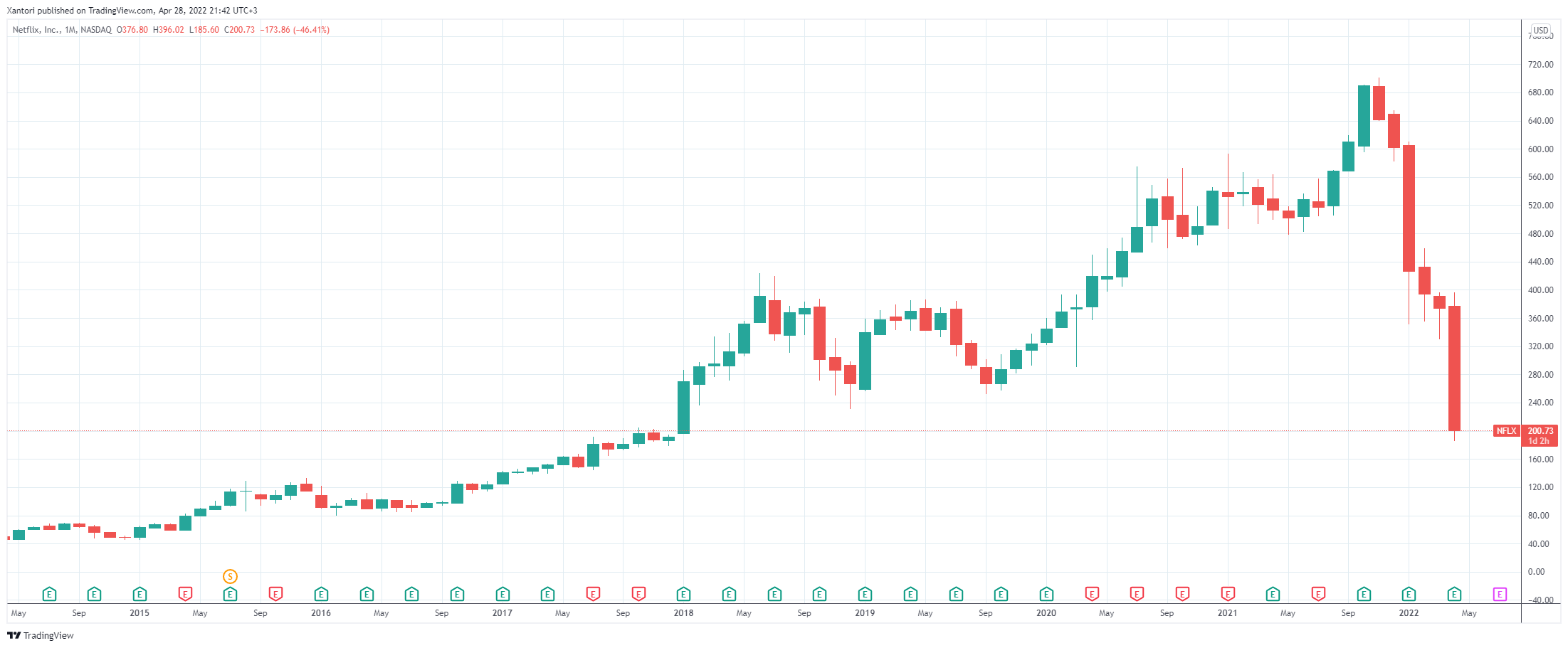
1-month NFLX chart
In the past six months, NFLX has been going through a real capitulation with an array of huge bearish candles. It’s obvious that the selling pressure will soon run its course and present a marvelous opportunity to “pick up the pieces” for those who are looking to invest in the top tech stock. We expect a strong bounce to the upside by the end of 2022.
- Pros: A highly reputable company with good potential for further growth once it overcomes the crisis.
- Cons: NFLX might go through a prolonged consolidation before showing real bullishness.
- Verdict: NFLX might present the best opportunity to buy the dip throughout the entire stock market.
Coinbase (COIN)

Coinbase is the cryptocurrency exchange that is ranked second in the world by trading volume after Binance. What’s interesting about this company is that it doesn’t have physical headquarters since all of its staff work remotely. It’s the youngest of the top tech stocks on our list since the company itself was founded only nine years ago, while the NASDAQ listing has been carried out in 2021, so the price history of its stock COIN is quite short.
Right now, it’s estimated that COIN has a tremendous Return on Assets of 20.6% and an even better Return on Equity of 69%, with a profit margin of 45.6%. At the same time, the low Price/Earnings Ratio indicates that the stock is undervalued. We believe that COIN’s Earnings per Share will be around 20% over the next five years, while industry experts predict a year-by-year growth of revenue of around 11%.
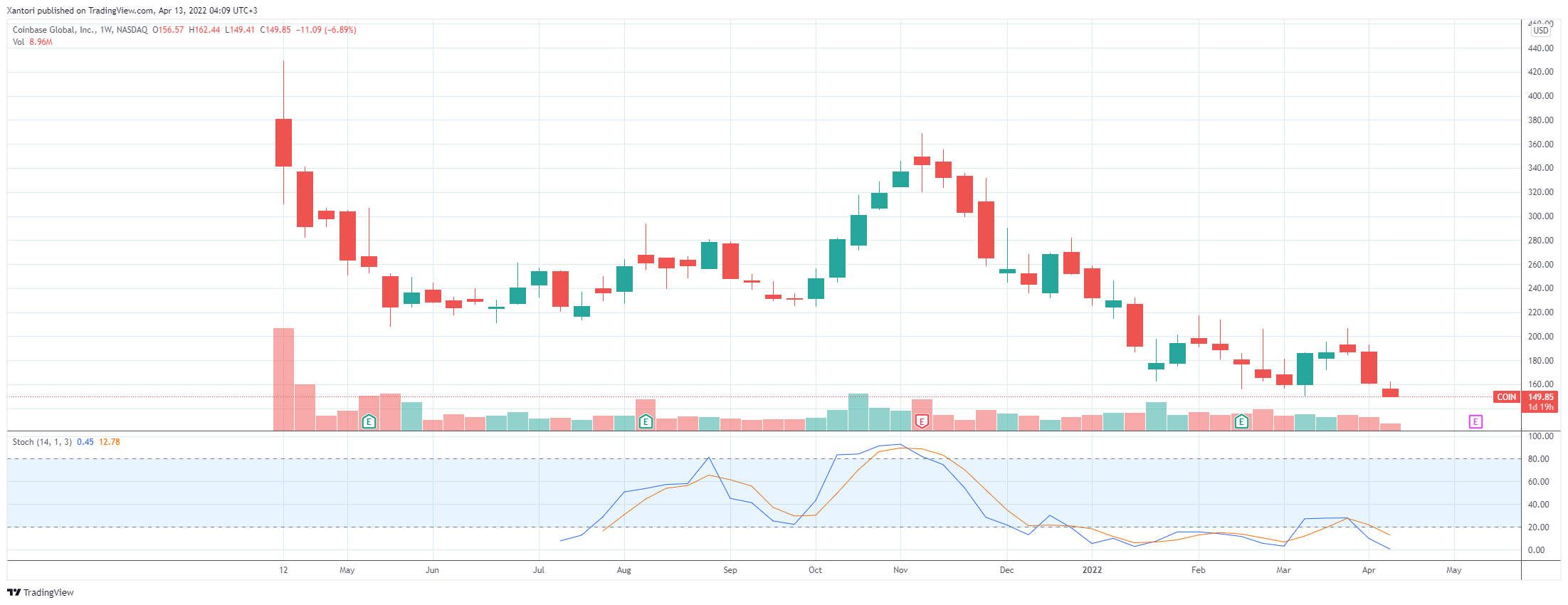
1-week COIN chart
Contrary to all stocks on this list, COIN has been in the downtrend since the NASDAQ listing despite great fundamentals. This situation is going to change in 2022 together with the adoption of more comprehensive crypto regulations, and the market is going to reverse since the stock is heavily oversold.
- Pros: Coinbase is a big player in the thriving industry.
- Cons: The market is still in a downtrend.
- Verdict: A definite buy after the trend reversal - crypto is here to stay.
Anaplan (PLAN)

Anaplan is a tech company from England that develops business planning software with an in-memory database and proprietary calculation engine. It doesn’t stand even remotely close to the size of other companies on this list - it has shown a modest revenue of $448 million - but it looks very attractive on the chart and has a great projected Earnings per Share of 47% for the next five years. Its stock PLAN is currently traded on NYSE.
The chart above shows that PLAN is a volatile stock that is prone to big price swings. We believe that the next bullish swing will take the price from $65 to $88 or above since the momentum and the volume are on the side of the buyers. PLAN isn’t the stock for holding but for profiteering since it has good upside potential but subpar fundamentals.
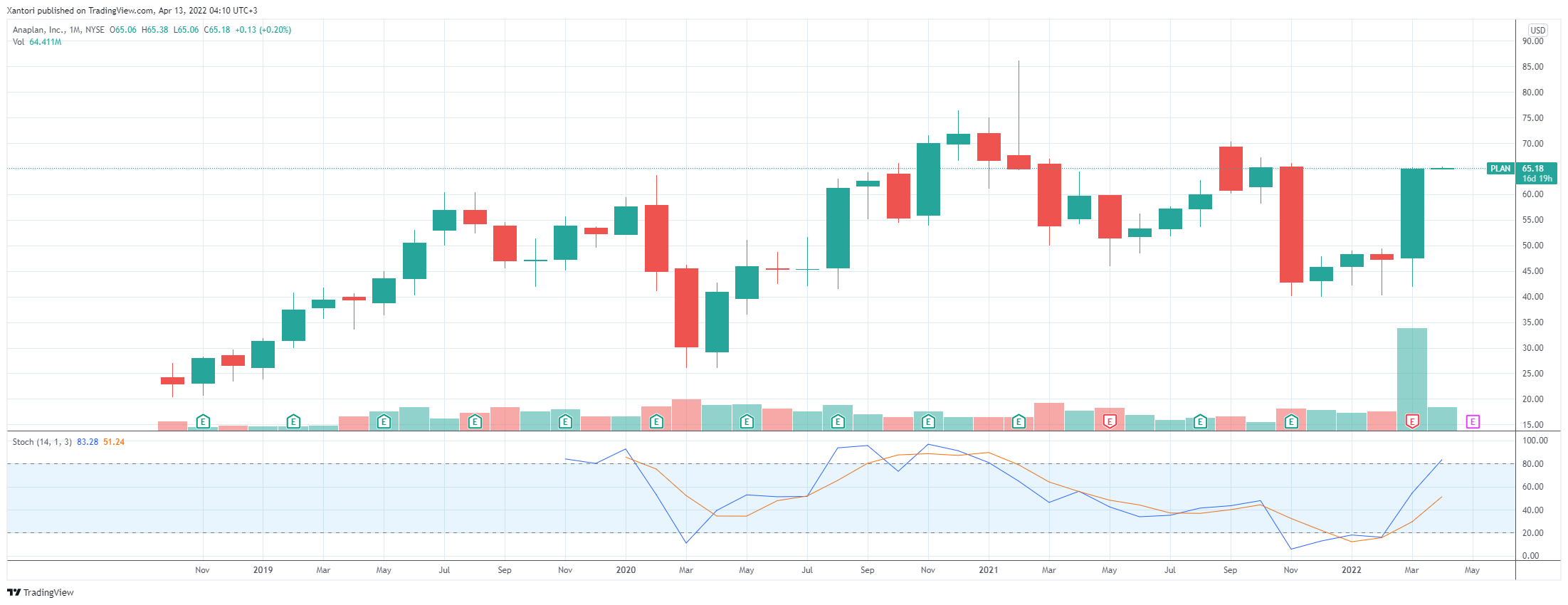
1-month PLAN chart
- Pros: PLAN is gearing up for the bullish swing.
- Cons: the company isn’t the best in the business.
- Verdict: Buy some, take profit and dump it.
Bottom line
The figures and charts for the stocks above show that the past decade has been great for tech companies since most of them enjoyed exponential growth in market capitalization and price appreciation of respective stocks. But it seems that most of them are entering the cooldown period for a better part of 2022, which presents a superb buying opportunity.
There is no doubt that tech companies will continue to thrive in the coming years since humanity is far from reaching the peak of technological progress. The blue-chip companies mightn’t have the same upside potential they had a decade ago, but the profits are still very much on the table, while they offer security and assuredness that most other tech companies lack.