The association between Bitcoin's price trajectory and the yields of U.S. 10-year Treasurys has been a focal point of extensive debates and analysis, thanks to the intriguing parallels and underlying economic logic found in historical precedents. U.S. Treasurys, or Treasury securities, are debt instruments issued by the United States Department of the Treasury to raise funds to finance the federal government's spending needs. These securities are considered one of the safest investments available as they are backed by the "full faith and credit" of the U.S. government.
Types of U.S. Treasurys:
- Treasury Bills (T-Bills): Short-term securities that mature in one year or less. They are sold at a discount to their face value and do not pay interest before maturity.
- Treasury Notes (T-Notes): Medium-term securities that mature between 2 to 10 years. They pay interest every six months and return the principal, or face value, when they mature.
- Treasury Bonds (T-Bonds): Long-term securities that mature in 20 to 30 years. Like T-Notes, they pay interest every six months and return the principal at maturity.
- Treasury Inflation-Protected Securities (TIPS): These are similar to T-Notes and T-Bonds but offer protection against inflation as their principal value rises with inflation and falls with deflation.
- Savings Bonds: Non-marketable securities intended for individual investors, which accrue interest until maturity or redemption.
Yield and Price:
- Yield: The yield of a Treasury security is the rate of return earned on the investment, and it moves inversely to the price of the security.
- Price: The price of a Treasury security fluctuates based on demand and supply, inflation expectations, interest rate expectations, and overall economic conditions. When demand is high, prices rise and yields fall, and vice versa.
Importance:
U.S. Treasurys play a crucial role in the global financial system. They are:
- A benchmark for interest rates worldwide.
- A haven for investors seeking safety during times of economic uncertainty.
- A tool for the Federal Reserve in implementing monetary policy.
Investors:
Investors in U.S. Treasurys include individual investors, institutional investors, and foreign governments. Many investors use Treasurys as a low-risk component in diversified investment portfolios. Additionally, central banks and governments worldwide hold U.S. Treasurys as part of their foreign exchange reserves due to their safety and liquidity.
Purchasing:
U.S. Treasurys can be purchased directly from the U.S. Treasury through the TreasuryDirect website or indirectly through banks and brokers. They can also be traded in the secondary market.
Economic Indicators:
The yields on Treasury securities serve as critical indicators of overall economic conditions, reflecting:
- Inflation Expectations: Higher yields may indicate rising inflation expectations, while lower yields may suggest the opposite.
- Economic Health: Generally, falling yields are associated with economic uncertainty or downturns, while rising yields often signal economic strength and growth.
- Monetary Policy Expectations: Yields are influenced by expectations regarding Federal Reserve policy actions, such as changes in the federal funds rate.
U.S. Treasurys are integral to the functioning of the global financial system, offering a risk-free investment option while simultaneously providing insights into economic conditions and expectations.
Analyzing Interrelations: Bitcoin Halvings and 10-Year Treasury Yields
Typically, assets like Bitcoin, perceived as high-risk, are likely to see diminished performance when investors flock towards the relative security of government-issued bonds. A chart disseminated by TXMC on the platform X (previously Twitter), suggests a noteworthy correlation where Bitcoin halvings appear to coincide with “relative local lows” in the 10-year Treasury yield.
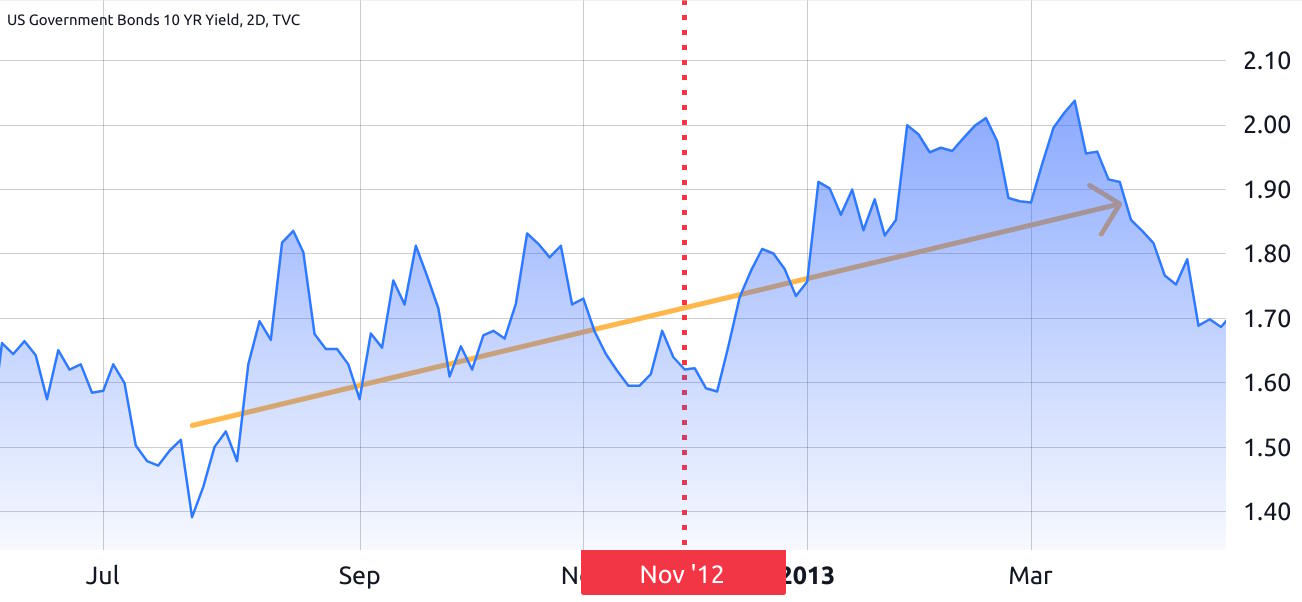
U.S. government bonds 10-year yield, 2012
While the term “relative” here may not accurately represent a defined three-month low, it does serve as a catalyst for a deeper examination of the macroeconomic conditions enveloping past Bitcoin halvings.
Interpreting Correlations: A Word of Caution
The author of the chart stresses that the highlighted correlation does not imply a direct, causal relationship between the yields and Bitcoin’s price. Furthermore, the assertion by TXMC that approximately 92% of Bitcoin’s supply is already in circulation leads to the suggestion that daily issuance is unlikely to significantly influence the asset’s value.
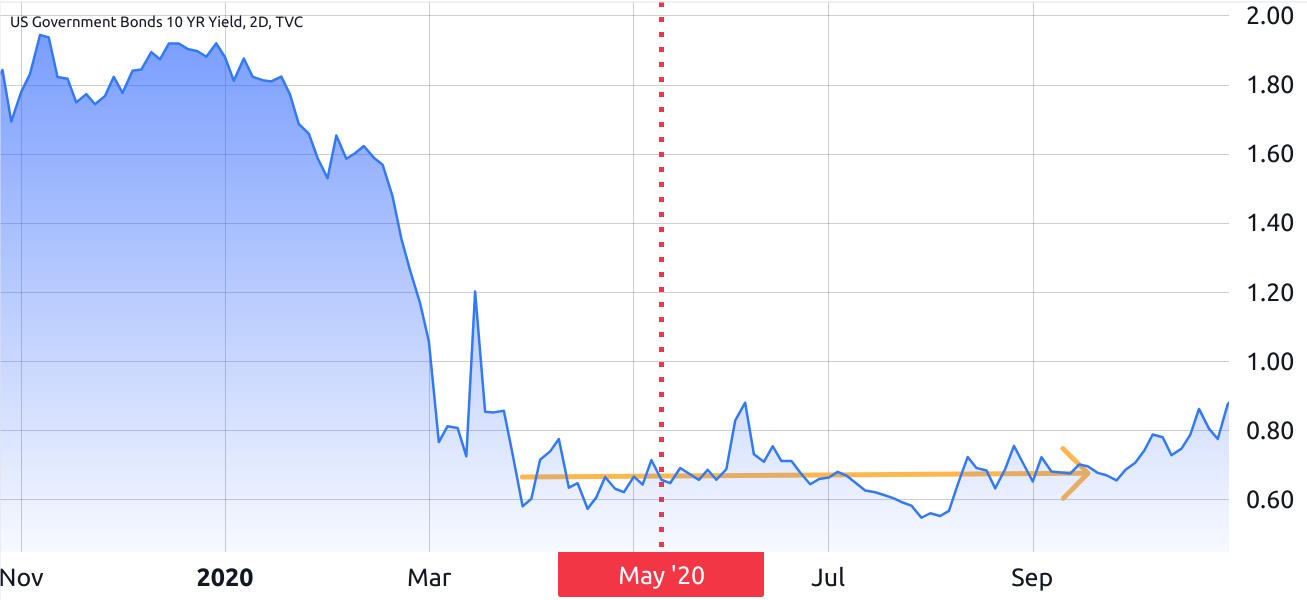
U.S. government bonds 10-year yield, 2020
Evaluating The 10-Year Yield Chart: Bitcoin’s Price Perspective
Human propensity to perceive correlations, irrespective of their validity, necessitates a cautious approach in evaluating such associations. For example, during Bitcoin’s inaugural halving, a consistent rise in the 10-year yield was observed, rendering it problematic to pinpoint that period as crucial for the financial metric.
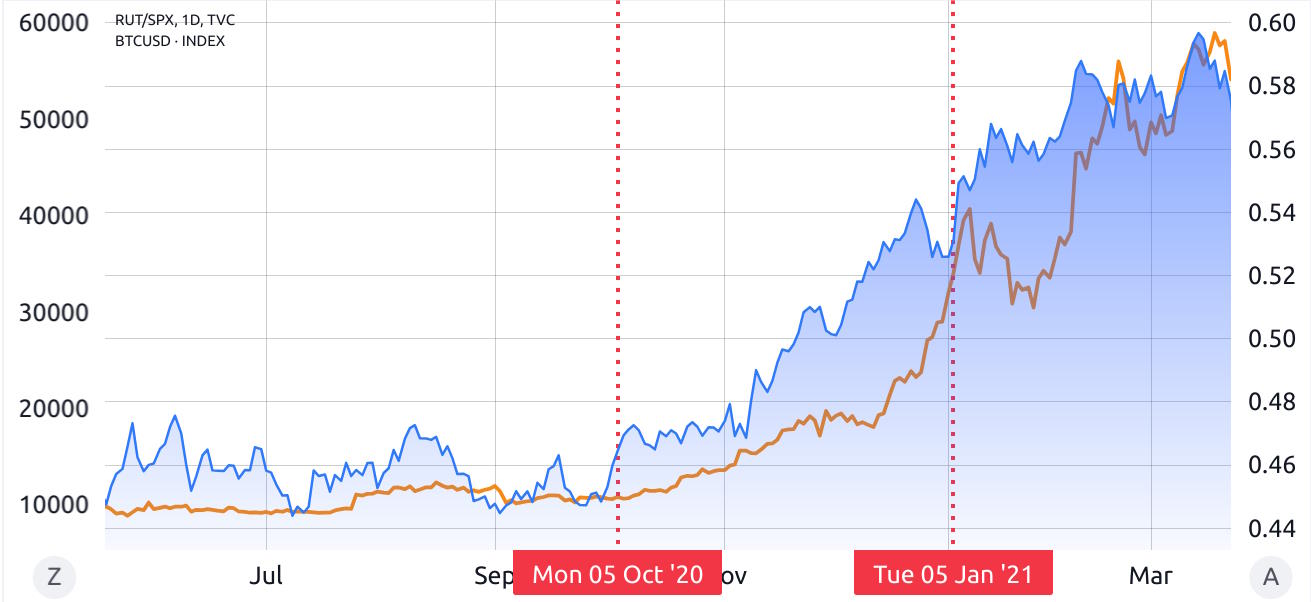
Russell 2000 small-cap index relative to the S&P 500 (blue, right) vs. Bitcoin/USD (orange, left)
Post the first Bitcoin halving, there was a discernible shift as fixed-income investors offloaded Treasurys, pushing yields higher. This transition is most compelling around Bitcoin’s third halving in May 2020, where yields dropped and sustained below 0.8% about 45 days pre-halving, maintaining that level for several months.
Unveiling the Subtleties: The Aftermath of Halvings
It is paramount to acknowledge that no two Bitcoin rallies are identical and attributing the momentum in Bitcoin’s value to a singular event, especially with ambiguous end dates, is statistically unwarranted. Between October 2020 and January 2021, a notable rally was witnessed, with Bitcoin escalating 247% in value, a significant leap five months post the third halving.
This raises critical inquiries regarding the surrounding macroeconomic climates and their potential influence on Bitcoin rallies.
During this value surge, the Russell 2000 Small-Capitalization index experienced superior performance relative to S&P 500 companies by 14.5%, indicating an investor inclination towards higher-risk assets, reflected by the disparity in the median market capitalization between Russell 2000 companies and the behemoths of the S&P 500.
Nuanced Approaches: Beyond Simplistic Correlations
Consequently, this shift towards riskier assets seems to be more aligned with an increased risk appetite among investors, rather than any discernible patterns in Treasury yields in preceding months. As such, reliance on isolated data points or oversimplified correlations is suboptimal when delving into the nuanced dynamics of Bitcoin’s value.
In conclusion, while the confluence of Bitcoin halvings and U.S. Treasury yields offers an intriguing perspective, it is crucial to approach these correlations with a discerning eye, recognizing the multitude of factors and the intricate interplay of macroeconomic elements shaping the trajectory of Bitcoin prices. A multifaceted approach, which considers various influencing factors and their subsequent interrelations, is indispensable for gaining a more holistic understanding of the evolving cryptocurrency marketplace.