The world of trading is ever-evolving, with various strategies emerging to help traders navigate the turbulent financial waters. One such strategy that has gained significant traction among seasoned and newbie traders alike is the Breakout and Retest strategy. This comprehensive guide aims to delve deep into the nuances of this strategy, offering valuable insights and practical steps for effective implementation.
Understanding the Breakout and Retest Strategy
At its core, the Breakout strategy is championed by traders who prioritize early-stage major price actions. When combined with astute technical analysis and stringent risk management, the strategy can offer an impressive reward to risk ratio. This has the potential to maximize profits and seize promising trading opportunities in the market.
One of the standout features that sets the Breakout and Retest strategy apart from other trading techniques is its adaptability. Whether you're dabbling in intraday, day trading, or other styles, this strategy remains relevant. The daily price action fluctuations in the market present myriad opportunities to capitalize on price breaks across different time frames. Its universal appeal and effectiveness under varied market conditions make it an invaluable tool for every trader's arsenal.
While the strategy is undoubtedly effective in the Cryptocurrency realm, its efficacy extends to the Forex market, magnifying its allure. Forex enthusiasts frequently harness this technique to discern potential support and resistance levels, arming them with invaluable insights for determining entry and exit points.
Anatomy of the Breakout and Retest Strategy
Mastering this strategy necessitates a firm grasp of its foundational concepts and the necessary technical tools. The strategy hinges on two pivotal components: the Break and the Retest. Both elements are quintessential for ascertaining the strategy's viability. The process is set in motion when an asset's price gathers momentum, breaking through the support or resistance level, often accompanied by a surge in trading volume. Charts may exhibit either a bullish or bearish breakout, with the former indicating a price surpassing the resistance level and the latter denoting a dip below the support threshold.
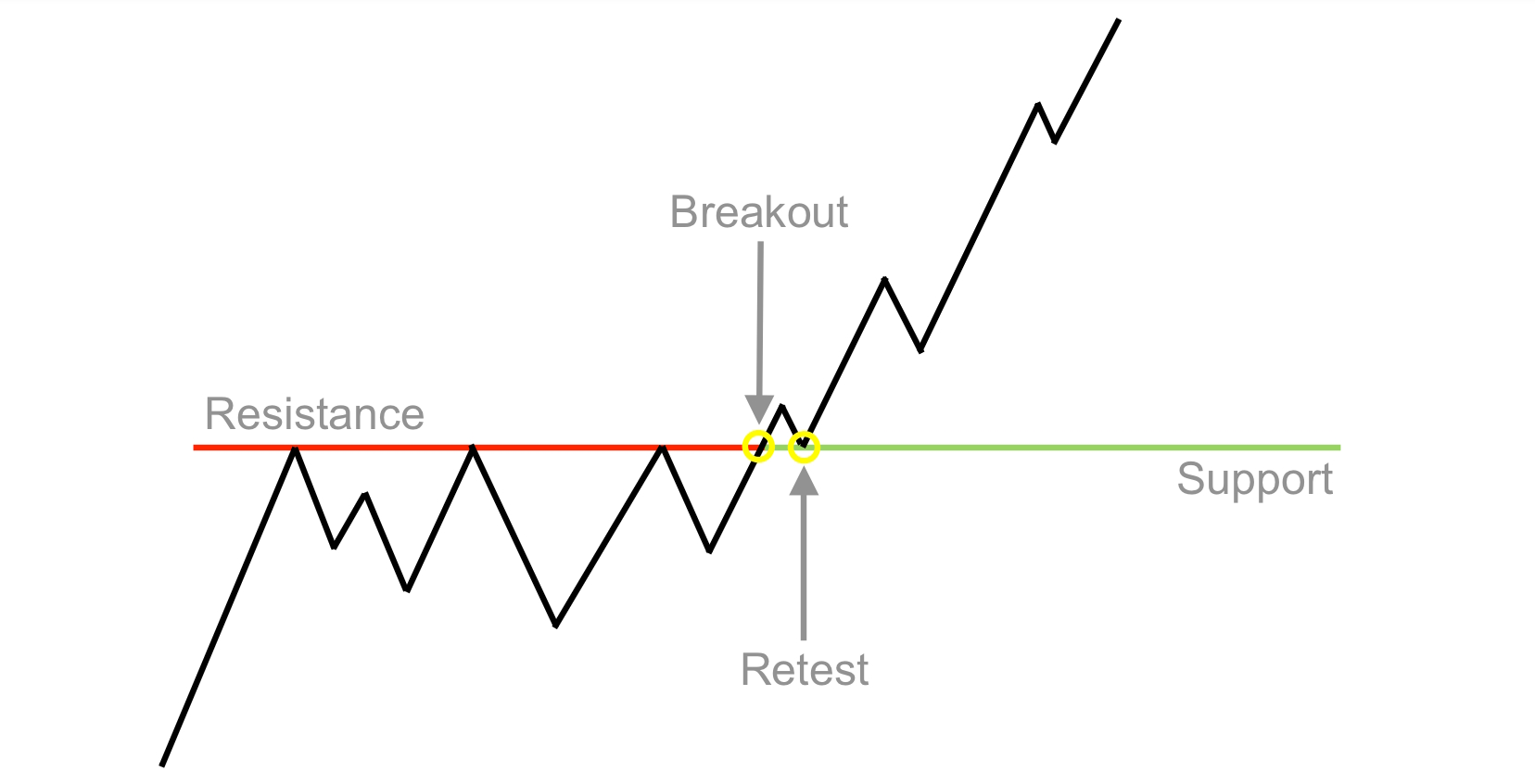
For the strategy to unfold seamlessly, the retest phase is paramount. When the chart showcases a price retracement back to its original support or resistance level, it heralds a potential trading opportunity. This retest phase gains legitimacy only when the price exhibits another retracement, reflecting the trend observed before the initial break. However, traders must tread with caution as this strategy doesn't always guarantee success, with false breakouts being a potential pitfall.
Deciphering Key Chart Patterns
Identifying ideal entry points necessitates recognizing specific candlestick patterns that emerge on the chart. These patterns furnish vital market condition data, essential for assessing and initiating a trade. Some pivotal patterns include:
- The Wedge Pattern: This represents converging trend lines within a narrowing price spectrum, signaling either weakening uptrends or downtrends.
- Consolidation: It denotes a horizontal price range, highlighting market indecision. Any break beyond this range can signal potential entry points.
- Triangles: Comprising ascending, descending, and symmetrical types, they indicate potential breaks in varying directions.
- The Channel Patterns: These parallel trend lines define support and resistance levels, signifying potential trading opportunities.
Complementing these patterns with technical indicators like MACD or RSI can provide added confirmation of emerging trends.
Implementing the Breakout and Retest Strategy: A Step-by-Step Guide
- Spotting Opportunities: Continually monitor support and resistance levels to detect break patterns. Rely on indicators like ATR, Volume, and Bollinger bands to gauge momentum.
- Determining Entry and Exit Points: Initiate trades post a valid retest and determine exit points based on trade outcomes. Setting clear profit objectives and realistic loss expectations can optimize results.
- Backtesting for Assurance: Platforms like TradingView or MT5 allow traders to test the strategy on historical data, providing insights into its effectiveness.
Weighing the Pros and Cons
Like all trading strategies, the Break and Retest method has its strengths and limitations. Its versatility, adaptability across markets, and suitability for both novice and expert traders are significant advantages. However, unpredictable price fluctuations and potential false breakouts can pose challenges.
Overtrading, especially in unfavorable conditions, can diminish profit potential and escalate risks. Thus, it's vital to exercise restraint and employ robust risk management practices.
In Conclusion
The Break and Retest strategy, with its robust framework and adaptability, can be a formidable tool in a trader's repertoire. However, like any strategy, it's not devoid of risks. A balanced approach, realistic goals, and sound risk management can pave the way for success, allowing traders to harness the full potential of this strategy while minimizing associated risks.