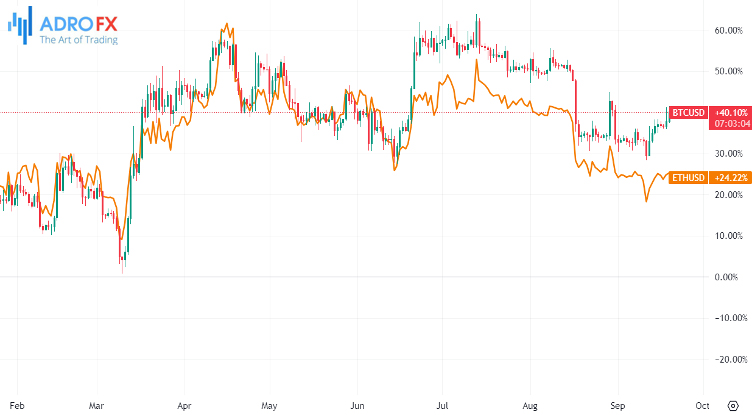
Amidst the tumultuous waves in the cryptocurrency ecosystem, Bitcoin (BTC) and Ethereum (ETH) continue to anchor their positions as titans of the crypto realm. This year alone, Bitcoin surged impressively by 65%, while Ethereum followed closely with a 40% rise. Though Bitcoin's recent stellar performance may make it seem like the prime contender for investments, it's fundamental to understand that past glories aren't predictors of future prospects. Here, we delve deeper into the elements that may sculpt the fate of these cryptocurrencies as preferred long-term assets.
Institutional Capital: Bitcoin’s Solid Ground
The role of institutional investment in steering the direction of cryptocurrencies remains paramount. Currently, Bitcoin is clearly the frontrunner in attracting institutional interest. Its reputation as a "digital gold" has solidified its status as a protective barrier against broader market volatility. This sentiment was palpable during a recent U.S. regional banking hiccup, which saw investors flocking to Bitcoin as a refuge, bolstering its value.
Furthermore, this year witnessed fervent discussions around the first-ever spot Bitcoin ETF. With potential SEC endorsement, the acceptance of a Bitcoin ETF could have resounding implications, potentially ushering a torrent of institutional capital into the crypto domain. At present, Bitcoin appears to be more alluring than Ethereum in this sector, signifying that as long as institutions favor Bitcoin, its capital influx might remain unmatched.
User Adoption: The Expanding Frontiers
User adoption serves as the lifeline for the longevity and relevance of any cryptocurrency. While both Bitcoin and Ethereum are making significant strides toward global assimilation, the real intrigue lies in the pace of this transition. Bitcoin’s projected adoption is promising, backed by comprehensive research from market influencers like Ark Invest.
Their findings suggest that Bitcoin could potentially carve out significant portions of the emerging market's M2 money supply, remittance asset market, and institutional assets by 2030. These projections could further amplify with global outreach.
On the other hand, Ethereum’s adoption forecasts derive inspiration from Metcalfe's Law, implying that Ethereum's valuation might follow a quadratic trajectory as its user community swells. The Layer 2 ecosystem, constituting blockchains built atop the main Ethereum chain, exemplifies this growth. Current analyses insinuate that, factoring in Layer 2's user engagements, Ethereum’s market cap could be undervalued by a staggering 25%.
Technological Evolution: Ethereum's Progressive Arc
Technologically, Ethereum seems to have the upper hand. Bitcoin, founded on the conventional proof-of-work mechanism, is energy-intensive. Ethereum, in a bold stride, transitioned to the more eco-friendly proof-of-stake system, achieving a whopping 99.9% energy efficiency through "The Merge."
Ethereum's roadmap is laden with ambitious upgrades, spearheaded by its visionary founder, Vitalik Buterin. With the much-anticipated evolution to "Ethereum 2.0," Ethereum aspires to evolve into one of the globe's swiftest and most fortified transactional networks.
The crypto realm is rife with speculations of "the flippening," where Ethereum could potentially eclipse Bitcoin in market cap. To realize this, Ethereum's developmental trajectory must decisively surpass Bitcoin's.
Conclusion
Despite Ethereum’s tantalizing potential, Bitcoin, holding approximately 50% of the entire crypto market cap, remains a preferred choice for many, both retail and institutional investors. As the scales currently stand, Bitcoin seems poised to retain its dominance in the near future. Deciding between BTC and ETH is a multifaceted equation, influenced by individual risk appetites, investment durations, and perceptions of their trajectories. Incorporating both in one's portfolio might also serve as a balanced approach, harmonizing potential gains with risk distribution.